
Marketing is evolving at a rapid pace, and in 2025, one of the biggest game changers is AI-powered marketing. According to PwC, AI could contribute up to $15.7 trillion to the global economy by 2030, with a significant share coming from improvements in marketing, sales, and customer engagement. Businesses that embrace AI in digital marketing are already seeing measurable results—studies show that 80% of marketers using AI tools report better customer insights, while 63% say AI has increased their campaign ROI.
So, what does this mean for your business? It means you no longer have to rely on guesswork, manual processes, or one-size-fits-all campaigns. AI-powered marketing helps businesses of all sizes make smarter decisions, create personalized experiences, and improve profitability.
In this beginner’s guide, we’ll break down what AI-powered marketing is, how it works, why it matters, and how you can start using it to stay ahead of competitors.
What is AI-Powered Marketing?
AI-powered marketing is the use of artificial intelligence technologies—such as machine learning, predictive analytics, and automation—to make marketing smarter, faster, and more impactful. Instead of traditional marketing that relies only on human judgment and limited data, AI processes millions of data points in real time to:
- Predict customer behavior and purchasing intent with up to 90% accuracy in some industries.
- Automate repetitive tasks like email campaigns, reporting, and A/B testing.
- Deliver personalized experiences at scale—something 71% of consumers now expect from brands (McKinsey, 2023).
- Continuously optimize ad campaigns to reduce wasted spend and improve ROI.
For instance, an e-commerce store can use AI to analyze browsing history, then show personalized product recommendations. This simple AI-powered strategy has been shown to boost sales by 20–30%.
The use of AI in digital marketing enables businesses to understand their customers better, act faster, achieve higher efficiency, and better scale outcomes as compared to traditional methods.
How AI Works in Marketing?
How many times have you observed Amazon recommend something that you may have recently thought of buying or maybe discussed with a friend? More often than not, it feels creepy. As if Amazon is listening to our conversations somehow. However, it’s nothing but sophisticated AI systems deployed.
AI in marketing follows a cycle designed to turn raw data into smarter decisions:
Data Collection: AI gathers customer interactions, search behavior, purchase history, and even social media engagement. According to Salesforce, 57% of marketers rely on AI to improve customer targeting through better data collection.
Pattern Recognition: Machine learning models identify hidden trends, seasonality, and customer preferences. For example, AI can detect that a customer who buys fitness gear in January is also likely to purchase supplements in February.
Predictions: Predictive analytics estimate future actions. Gartner reports that predictive marketing can increase conversion rates by up to 20% by anticipating customer needs before they express them.
Automation: AI executes tasks in real time, like sending personalized emails or adjusting ad bids. This reduces manual work and ensures campaigns are always optimized.
Benefits of AI-Powered Marketing for Businesses
The benefits of AI marketing extend far beyond automation—they directly impact the bottom line. Some key benefits include –
Personalization at Scale: Personalized product suggestions increase customer satisfaction. According to Accenture, 91% of consumers are more likely to shop with brands that provide relevant offers and recommendations.
Smarter Decision-Making: Data-driven insights help businesses reduce risk. For example, AI can forecast sales trends with up to 95% accuracy, empowering better inventory and campaign planning.
Efficiency & Cost Savings: AI can cut repetitive manual tasks by 40%, freeing up teams to focus on strategy.
Higher ROI: AI-optimized ad targeting has been shown to reduce cost per acquisition (CPA) by up to 30%.
24/7 Engagement: Chatbots powered by AI handle thousands of customer inquiries instantly, increasing customer retention by providing fast, reliable responses.
For instance, one of our clients – a notable luxury retail brand in Delhi, using AI-driven ads, lowered its cost-per-click (CPC) by 28%, while increasing sales by 15% within three months.
Real-World Examples of AI in Marketing
AI is no longer a future concept—it’s a present-day driver of competitive advantage across industries. Here are deeper examples of how AI in digital marketing is changing business operations and the clear advantages these shifts bring:
Product Recommendations: Amazon credits 35% of its revenue to AI-powered product suggestions. Netflix uses similar algorithms to keep 80% of viewing activity within personalized recommendations. This reflects how predictive engines not only drive sales but also increase engagement and retention, keeping users on platforms longer.
Chatbots & Customer Support: Businesses deploying AI chatbots report a 67% increase in lead generation and reduced support costs by up to 30%. Beyond cost savings, chatbots ensure 24/7 availability, providing customer convenience that directly translates into loyalty and higher lifetime value.
Ad Optimization: Google Ads’ Smart Bidding has improved ROI by 20% on average for advertisers. AI continually refines targeting, ensuring the right message reaches the right audience at the lowest cost. This brings efficiency to paid media, helping companies stretch smaller budgets further while outperforming manual optimization.
Content Creation: AI copywriters like Jasper and ChatGPT enable content teams to scale production, with studies showing 50–80% reduction in writing time. This doesn’t just lower costs—it allows businesses to respond faster to trends, publish more consistently, and cover more niche keywords, boosting SEO visibility.
SEO Optimization: Tools like Clearscope and Surfer SEO analyze 500+ ranking signals and competitor content to improve rankings. This helps smaller businesses compete with enterprise sites by leveling the playing field with data-driven insights.
Email Marketing & Personalization: Brands that utilize AI personalization in their email campaigns have seen open rates increase by 26% and click-through rates rise by 41%. These improvements directly impact conversions and revenue.
These real-world examples highlight a critical advantage – AI transforms marketing from reactive to proactive. Instead of reacting to customer behavior after it occurs, AI predicts and adapts campaigns in real-time. This agility allows businesses—big or small—to operate smarter, scale faster, and create lasting customer relationships that traditional methods cannot achieve.
Case Study: Two Startups, Two Different Paths
To illustrate the impact more clearly, let’s compare two startups in the same niche—local fitness apparel—in the same city:
Startup A (Traditional Marketing): Relies on manual social media posts, generic email blasts, and offline promotions. Growth is slow because campaigns are not personalized. Their conversion rate hovers around 2%, and marketing costs are rising as competition intensifies.
Startup B (AI-Powered Marketing): Leverages AI tools for customer insights, personalized email campaigns, and predictive ad targeting. AI-driven product recommendations increase average order value by 18%, while automated ad bidding reduces cost per acquisition by 25%. Within one year, their conversion rate climbs to 4.5%, nearly doubling Startup A’s performance.
Growth Trajectory Comparison
Year 1: Both startups start at the same revenue baseline. Startup A grows at 5%, while Startup B grows at 15% thanks to AI efficiency.
Year 2: Startup A struggles with scaling due to higher marketing costs and stagnant engagement. Startup B integrates chatbots, cutting support costs by 30% and improving customer satisfaction scores by 40%. Revenue now outpaces Startup A by 2x.
Year 3: Startup A continues incremental growth at 5–7% annually, while Startup B achieves compound growth above 20% annually, capturing more market share and reinvesting savings into innovation.
This comparison demonstrates how AI in digital marketing provides a compounding advantage: greater efficiency, stronger personalization, and faster scalability, even when competing in the same industry and location.
Top AI Marketing Tools for Beginners
For beginners, selecting the right AI marketing tools is crucial. Here are some of the top-rated, beginner-friendly tools filtered by category and purpose.
Chatbots: Drift, ManyChat – reduce response times by up to 70% and improve lead qualification rates.
Email Marketing: Mailchimp AI, Brevo, ActiveCampaign – AI personalization can boost open rates by up to 26% and increase conversions by approximately 41%.
Content Marketing: Tools like Jasper & Copy.ai – cut content creation time in half while improving SEO alignment by analyzing keywords and competitor pages.
Analytics: Google Analytics 4 – leverages AI insights for predictive metrics like churn probability and revenue forecasting.
Advertising: Google Ads Smart Campaigns – optimizes ads with 15–20% better click-through rates, lowering wasted spend.
Tip: Start with one or two tools and expand as your business sees measurable ROI. These tools level the playing field, giving startups access to enterprise-grade technology at affordable prices.
Challenges & Misconceptions About AI Marketing
While AI in digital marketing offers undeniable benefits, there are still myths and challenges that businesses must address to use it effectively:
- Myth AI will replace human marketers: AI is a complement, not a replacement. It automates repetitive, data-heavy tasks so human marketers can focus on strategy, creativity, and building authentic customer relationships. Companies that blend human creativity with AI efficiency achieve the strongest results.
- Myth – AI is too expensive for small businesses: Thanks to SaaS models, many AI tools start as low as $20–$50 per month, making them accessible for startups and SMBs. For instance, AI-driven email marketing platforms have shown 26% higher open rates even for businesses with modest budgets.
- Challenge: Data Privacy & Compliance. With stricter regulations like GDPR in Europe and the DPDP Act in India, companies must ensure AI systems handle data transparently and ethically. Failure to do so can lead to fines, reputational damage, and loss of customer trust.
- Challenge: Integration & Learning Curve. Adopting AI requires time and training. McKinsey reports that organizations that invest in structured AI training see adoption rates that are 2.5x faster and ROI that arrives within the first 12 months.
- Challenge: Dependence on Data Quality. AI systems are only as effective as the data they are trained on. Poor-quality or incomplete data leads to weak predictions. Businesses must prioritize clean, well-structured, and ethically sourced data.
Key Takeaway: Overcoming these misconceptions and challenges positions businesses for long-term success. By investing in training, adopting affordable AI solutions, and implementing strong data governance, companies can harness AI’s potential without falling into common pitfalls.
Step-by-Step: How Businesses Can Start with AI Marketing
Getting started with AI-powered marketing does not have to be overwhelming. Businesses that succeed typically begin with clear goals, small pilot projects, and a focus on measurable impact. Here is a roadmap:
- Define Clear Objectives: Identify where AI can add the most value. Is your priority reducing ad spend, improving email engagement, or enhancing customer support? Companies with specific goals are 3.5x more likely to achieve ROI from AI adoption.
- Start Small with One or Two Tools: Rather than a full-scale transformation, begin with one or two AI solutions. For example, adopt an AI-powered email marketing tool to personalize campaigns or a chatbot to handle FAQs. HubSpot reports that businesses using AI chatbots cut support costs by 30% in the first year.
- Train and Upskill Your Team: AI tools are powerful but require human guidance. Deloitte found that companies investing in AI training see adoption 2.5x faster than those that do not. Providing workshops and tutorials helps staff embrace AI as an enabler rather than a threat.
- Track and Measure Performance: Define KPIs upfront, such as conversion rates, customer lifetime value (LTV), or cost per acquisition (CPA). A/B testing campaigns before and after AI implementation highlights measurable gains. For example, businesses that introduced AI ad optimization saw CPA reductions of 20–30%.
- Scale Gradually: Once initial wins are proven, expand AI integration into predictive analytics, content generation, or programmatic advertising. Over time, this compound effect drives consistent growth and deeper customer relationships.
At Ananta Akshar, we guide businesses through this journey—helping them identify the right tools, train their teams, and achieve measurable results with AI-powered marketing.
The Future of AI-Powered Marketing
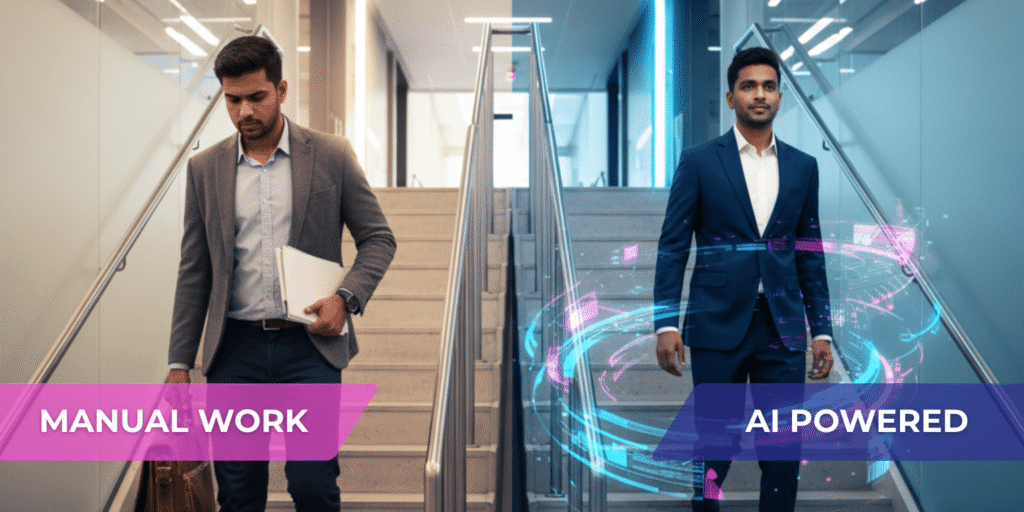
The next five years will bring transformational changes to the marketing landscape. Businesses that adopt AI early will enjoy competitive advantages that compound over time.
- Hyper-Personalization: By 2030, 80% of customer interactions will be AI-driven, delivering experiences so personalized that no two customer journeys are the same. Retailers using hyper-personalization have reported revenue lifts of 10–20%.
- Voice and Conversational AI: With the number of voice assistants projected to reach 8.4 billion by 2026, brands must prepare for voice-based search and commerce. Domino’s, for example, already allows customers to order pizza through smart speakers—an early sign of how voice will reshape purchase behaviors.
- Predictive Customer Journeys: AI will not just react to customer behavior—it will anticipate it. This shift will improve customer retention by 30% or more, as businesses will intervene before churn happens. Imagine an AI-powered CRM that predicts when a client is likely to leave and suggests personalized retention strategies.
- Ethics and Regulation: As AI grows, so will scrutiny. Governments worldwide are developing policies to regulate AI use, ensuring fairness, privacy, and accountability. Brands that adopt transparent, ethical AI practices will gain customer trust and strengthen their long-term reputation.
These changes reflect not just technological evolution, but a new marketing mindset – customer-first, predictive, ethical, and scalable.
Conclusion
AI-powered marketing is no longer a luxury—it is a necessity for businesses that want to grow, compete, and thrive in 2025 and beyond. From personalization at scale to data-driven decision-making and ROI-focused campaigns, AI enables businesses of all sizes to deliver smarter, faster, and more effective marketing.
The difference between businesses that adopt AI and those that do not will only widen over time. Just as digital marketing transformed the past decade, AI will define the next.
Ready to future-proof your brand’s marketing with AI? Contact Ananta Akshar today to start your journey.